
Furnace install
Furnace Install in Whitehall, MT
A furnace performs the way it is installed. Ours go in with calculated sizing, correct venting and gas sizing, and commissioning numbers we hand you at the end.
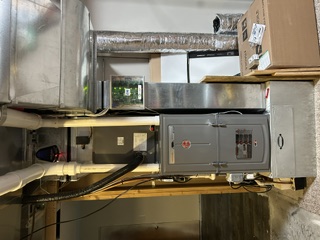
Sizing and selection
We calculate the heat load from the building — insulation levels, window area, air leakage, ceiling heights and our local design temperature — and check it against what your duct system can actually move. Equipment gets chosen to fit both numbers. Oversizing is the most common install mistake in this valley, and it costs comfort, fuel and equipment life.
From there you pick efficiency and staging with real cost figures in front of you: single-stage versus two-stage, PSC versus variable-speed blower, 80% versus condensing. We explain what each does in a Montana winter and what it does to your bill.
The install itself
Set level on a proper base, sealed transitions to supply and return, a serviceable filter rack sized so the filter is not the restriction, gas piping sized for the run and leak-tested, venting with correct slope, support and termination clearances, condensate with a trap and freeze-safe routing, and clearly labeled thermostat wiring.
Then commissioning: manifold gas pressure set for altitude, temperature rise inside the manufacturer's window, static pressure measured, blower speed configured for long low-load operation, safeties tested and combustion verified. You get the numbers and a walkthrough before we leave.
Working with your existing ductwork
New equipment on undersized or leaky ductwork disappoints everybody. During the quote we measure static pressure on the current system, look at return paths, and flag the duct work needed for the new furnace to hit its rated performance.
Sometimes that is a bigger return grille and a proper filter rack. Sometimes a trunk needs upsizing. We would rather tell you before you buy than explain a rise problem afterward.
Local knowledge
Built for Whitehall and the Jefferson Valley
At Whitehall's elevation, gas furnaces must be derated and combustion adjusted for the thinner air. It takes minutes on installation day and it is routinely skipped — with sooting and short equipment life as the consequence.
Winter design temperatures well below zero mean long low-fire runs rather than short blasts. We set blower speeds and staging for that pattern, which is what makes a new furnace feel steady instead of drafty.
Questions & answers
Frequently asked questions
How long does a furnace install take?+
Usually one day for a replacement in an existing location. New construction, fuel conversions, relocations and vent conversions can take two.
80% or high-efficiency for a Montana winter?+
Both are valid. Condensing furnaces save real fuel over our long heating season but need PVC venting and a condensate path. 80% units are cheaper to install and vent conventionally. We price both against your actual usage.
Will a new furnace fix my cold rooms?+
Only if the cause is the furnace. Cold rooms are usually a duct and airflow problem, which is why we measure static pressure and look at return paths before quoting, and tell you what duct work the new equipment needs.
Do you handle permits and code requirements?+
Yes. Venting clearances, gas sizing, combustion air and condensate all get done to code, and we handle the paperwork your jurisdiction requires.
Related services
Other work we do nearby
Heater Install
New heating equipment selected and installed for real Montana design temperatures — gas furnaces, unit heaters and add-on heat for spaces ductwork never reached.
Heater Repair
No heat, weak heat or a heater that quits mid-cycle — measured diagnosis and a firm price before the repair starts.
Heater Maintenance
Yearly cleaning, safety testing and tuning so your heat is ready before the first hard freeze in the Jefferson Valley.
Furnace Replacement
Honest repair-versus-replace math, then a clean change-out sized and vented correctly for our altitude.
Furnace Maintenance
Annual furnace cleaning and safety inspection — burners, flame signal, heat exchanger, draft and temperature rise.
Furnace Repair
Ignition faults, short cycling, blower failures and no-heat calls repaired the first time, with a free consultation.
Price a properly installed furnace
Call (406) 266-1675 or request a free quote. We'll calculate the load, look at your ductwork and venting, and give you a written price with the details spelled out.